Macaroni Cereal or Falling Down a Hill: A Comic About AI Art & Writing

You’ve heard enough about generative AI to last a lifetime, but have you read this comic?
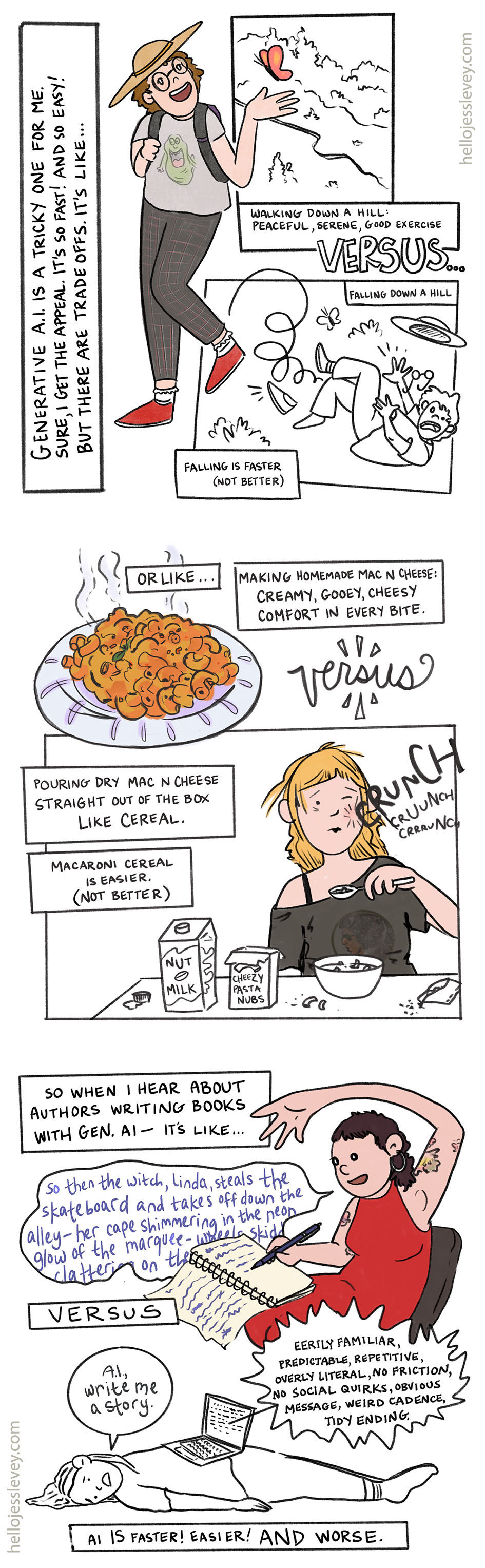
I’m not anti-technology, or some luddite with a cute haircut and too many shades of black in her closet (although my haircut is super cute thanks to an awesome stylist named Angie at Trim Salon in DC, and you can never own too many shades of black).
I love technology! I love electric buses, high-speed rail, and rocket ships. I love my iPad, microwaves, and 3D mammograms. I love contactless payment systems, Wi-Fi at the art museum (where I’m typing this rant right now), and being able to watch The Mummy at a cruising altitude of 30,000 feet. I love technology that helps us find community, care for ourselves and others, and experience the beauty of life.
But I don’t love generative AI. Why?
There are a bunch of reasons I guess: that it only “generates” by mimicking and remixing real people’s lifeworks without their permission or knowledge; that the data centers responsible for making gen AI fast, free, and convenient are also responsible for disrupting and devastating local ecosystems; that it’s being used to replace workers who rely on entry-level jobs (disproportionately young workers, part-time workers, disabled workers, people of color, immigrants, and women), as well as high-wage knowledge jobs (a lot of other people); and that there are little-to-no regulations or plans for preserving our country’s economy or information systems as reliance on this disruptive technology increases.
But also, I don’t love generative AI because it’s mediocre.
AI platforms like ChatGPT, or Gemini, or Claude, are marketed as tools that make tasks faster and easier to do, with no consideration for whether or not the outcome is any good. (Spoiler: It’s not good.)
In fact, Google’s AI Mode helps the Tech Giant make money by being bad at its job: The Best Place to Hide a Dead Body (How to Avoid Google’s Algorithm & Individual Bias)
I speak from experience. In a “know thy enemy” approach, I’ve experimented with using ChatGPT and Gemini to review my writing, to offer feedback on ideas or help me brainstorm, and to suggest structural changes to long form written projects. I have to be adept at using AI to be employable in my field, so I am, which is an uncomfortable double-edged sword. At first, AI’s various feedback seems too good to be true – it’s instant, friendlier and more consistent than most peer feedback, and you don’t have to hide your insecurity while asking the same question over and over in different ways. (And AI tells you you’re brilliant! Creative! Correct! Definite points for ego stroking, I guess?)
But after a while, something else becomes clear – the responses are predictable, frictionless, beige. There are no hot takes, no unexpected leaps, no personal experience just below the surface, offering a vulnerable and interesting angle. It’s low-stakes, lukewarm, and weirdly manipulative – a word calculator trying to sound human.
AI might be really good at one thing, but that thing is gradually making everyone sound the same. Maybe gen AI isn't the enemy, but it's not your friend either.
What is Generative AI?
Generative AI is a mathematical system, statistical model, or “large language model” that works kind of like a word calculator. It’s been taught hundreds of billions of words (and interactions) that it then uses to generate an “original” human-like response to a prompt. This response is meant to mimic the tone, nuance, and personality of a human – but because language models aren’t capable of true thought or emotion, the results often feel unnatural and not-quite-right.
Generative AI models can’t “create” anything the way people do. They don’t have imaginations (although they do have hallucinations!). These massive language models break down all those billions of bits of information they steal* into mathematical patterns, which remix the words, images, and interactions they’ve been taught into a “likely” arrangement based on statistics. The model has been programmed with the goal of generating an output that resembles these original works, without spitting out an exact replica. That’s why so many generative works are familiar – they are remixes of real work created by real people.
*Don’t like the word “steal” here? How about “scrape,” “ingest,” or “consume,” until we hear how those lawsuits turn out.
Read a content writer's take on AI in the industry: No, I Won’t Train My AI Replacement, Actually
Some Facts About How Generative AI Impacts Us
I'm a content manager and content writer by day, cartoonist and zine maker by night. I also write short stories and long-form fiction (mostly speculative fiction and narrative essays these days). So, I spend a lot of time thinking about how AI impacts these roles. But I'm not the only one! Here are some recent findings, gathered by very smart folks, about the risks and impacts of generative AI:
"Generative AI has the potential to widen the racial economic gap in the United States by $43 billion each year... Gen AI will likely alter professional pathways that Black workers rely on to move from low-wage to higher-paying roles...Ultimately, between 2030 and 2060, gen AI may be able to perform about half of the gateway or target jobs that many workers without degrees have pursued—closing a pathway to upward mobility that many Black workers have relied on..." (from "The impact of generative AI on Black communities," 2023, McKinsey & Company)
37% of company leaders and hiring managers say they would rather have a robot/AI do a job than hire a recent Gen Z graduate. (from "Survey: Traditional Degrees Hinder Graduates at Work," 2025, Hult International Business School)
"Workers between the ages of 22 and 25 have experienced a 13% relative decline in employment since 2022, in occupations most exposed to AI." These high-exposed roles include customer service rep jobs, accountants, and software developers. (from "AI adoption linked to 13% decline in jobs for young U.S. workers, Stanford study reveals," 2025, CNBC)
"Entry-level jobs in the US have fallen by 35% in the last 18 months, in large part because of AI, according to research firm Revelio Labs... A look at today’s job market suggests new entry-level roles are evaporating as leaders across industries embrace artificial intelligence (AI) to handle foundational tasks, from data entry to coding to customer support." (from "How AI is changing the nature of entry level work," 2026, World Economic Forum)
"Women are disproportionately exposed to Gen AI for three main reasons: they are overrepresented in jobs most susceptible to automation; they remain underrepresented in AI-related and science, technology, engineering and mathematics (STEM) occupations; and AI systems themselves often reflect and reproduce the gender biases embedded in societies... Around 29 per cent of female-dominated occupations are exposed to GenAI, compared to just 16 per cent of male-dominated occupations. The difference is even starker when looking at high automation risk: 16 per cent of female-dominated occupations fall into the highest exposure categories, compared to only 3 per cent of male-dominated ones." (from "New ILO data confirm women face higher workplace risks from generative AI than men," 2026, International Labor Organization)
"The impacts [of data center construction] on communities' air quality, groundwater quality, and hazardous waste concentration are not evenly distributed across the country. Big Tech and data center developers appear to be siting data centers in vulnerable communities, from Memphis, TN, to Colleton County, SC, to Dallas, TX. These locations show a troubling trend -- they primarily impact working-class and Black and Latine communities." (from "The Unequal Burden of Data Centers," 2025, Kapor Foundation)
"Music creators could see their revenues fall by 24 per cent [by 2028], while those working in the audiovisual sector may lose 21 per cent of their income due to the expanding presence of AI generated content in global markets." (from "Artists face steep income decline due to AI, UNESCO finds," 2025, United Nations UN News)
Still, gen AI does have clear uses, and some sources say there has been rapid adoption in creative fields despite the risks...
"76 percent of creators say creative generative AI is positively shaping the creator economy, helping them reach new audiences, scale their businesses, and amplify their creative expression." (from "Inaugural Adobe Creators' Toolkit Report: 86 Percent of Global Creators Use Creative Generative AI, See it Boosting Creator Economy," 2025, Adobe Newsroom)
But it's kinda weird that Adobe's data is so different from studies conducted by researchers who don't profit off of AI, isn't it? I guess we'll see.
